About
A product, a discipline, and engineers who build on both with your team.
BtSavvy is a full-stack engineering company built around FORGE, our engineering platform. Our forward-deployed engineers bring the product and the method into your repositories, your cloud accounts and your controls. They build new systems and rebuild the ones you already run. AI does most of the writing, investigating and checking. People own the decisions that carry risk. Your team learns FORGE and the engineering discipline as the work happens, and keeps both when we leave.
AI gave every enterprise many more people who can produce working code. It did not add architects, security engineers or operators, and safe to ship still runs through them.

That is the gap BtSavvy exists to close. It is an engineering problem before it is a hiring one, because that judgement cannot be recruited at the pace the building now happens. It can be captured once and built into the path each project takes to production.
FORGE is how we do that. It is our product, an engineering platform, and the method that runs on it. Your architects, security engineers and platform teams put their standards into it once. For each project, FORGE turns those standards and the project's requirements into the environment the system is built, deployed and operated in. Your developers keep the AI tools they already use. The result meets your standards and carries the record of who decided what. If it runs in the cloud, it also arrives with its own operator.
BtSavvy is the company that built FORGE and builds on it. We are a product-anchored engineering company, and we do not staff projects with general-purpose engineers. We bring the platform, the method and people who work in it every day. With your team, they deliver governed, production-ready systems on a repeatable foundation.
The argument
Software built with AI is safe to ship when two things hold. It was built to your standards and security controls, and it stays governed and supportable in production. FORGE makes both properties of the same design. Your standards become part of the path to production. The pipeline is generated from your policy, so the team it constrains does not write it. The checks and their evidence run as the work happens. Because the application is written inside FORGE, a cloud application's operator is built from the same design. It arrives with the application and starts out knowing it. Build and operation share one record, so nothing is lost at handover.
That changes what you can build for yourself. You could rent a capability as software as a service (SaaS) and shape your business around it. Instead, your team can build its own on FORGE and run it as a service for the rest of the business. It is held to the reliability, operations and evidence a SaaS provider expects of itself. FORGE brings the design, the tooling and the operator, so your team writes only the part that is specific to how you work. You keep the application, its code and its delivery records.
The same path rebuilds a system you already run. FORGE recovers what the old system does from its code, its documents and its behaviour on real inputs. The replacement is measured against that recorded behaviour, and the old and the new run side by side on real traffic until you are satisfied. For a regulated product, the record a regulator asks for comes out of the build rather than being assembled afterwards.
The Methodology page explains the method and the Engineering Brief gives the technical detail. The FORGE Platform page describes what the platform is and what it produces.
How we deliver
We offer eight services, each bought on its own.
AI Strategy & Architecture sets the direction, and it is the one service not delivered on FORGE. Build is full-stack product engineering: user interfaces, services, data and integrations. Data Foundation builds the data layer an AI system's accuracy depends on, with what anyone can retrieve bounded by what they are allowed to see. Cloud and DevSecOps design your cloud against your standards and generate each project's pipeline from your policy. Governed Enablement puts business-built applications under the same guardrails as engineer-built ones. Run and Assurance keep a system governed once it is live and hand over its evidence. Your standards go into FORGE once, so a single service bought alone still runs under them.
For the seven services delivered on FORGE, you choose who leads the work. BtSavvy's engineers can deliver it. Or your team builds it with our engineer beside them, teaching FORGE and the method as they go, so the capability stays with you. Work enters at whichever service fits where you are, and most engagements begin with the FORGE Diagnostic. A Proof then takes one use case into production, and a First Build takes one application end to end. Strategy to Run joins strategy, engineering and operations in one engagement.

Forward-deployed means inside your environment. Our engineers work in your repositories and your cloud accounts, against the internal systems the application has to work with. You set the access, and every touch is logged. The first look at your cloud account is read-only, and nothing in it changes until a person on your side has agreed. Nobody deploys from a laptop: code goes to source control, source control starts the pipeline, and the pipeline deploys. During secret setup, values go straight into your vault without passing through the AI tools or a temporary file. Each deployment identity is scoped to its own work.
We deliver on AWS, Azure, Google Cloud (GCP) and Oracle Cloud (OCI), whichever the workload needs. Full DevSecOps runs on all four, with the pipeline tooling you already have, hosted or on premises. The cloud and the pipeline use the provider's own modules where they fit. Where they do not, the modules come from our labs. A cost ceiling agreed at the start is checked against projected cost before anything is deployed. Your code, your data and your applications stay in your accounts.
Where we work
Our engineers work where your system lives: inside your repositories, your cloud accounts and your controls, on AWS, Azure, Google Cloud and Oracle Cloud. They work alongside the people who will own the system, in your tools and under your access rules. The work is visible to you as it happens. What is built stays in your accounts.
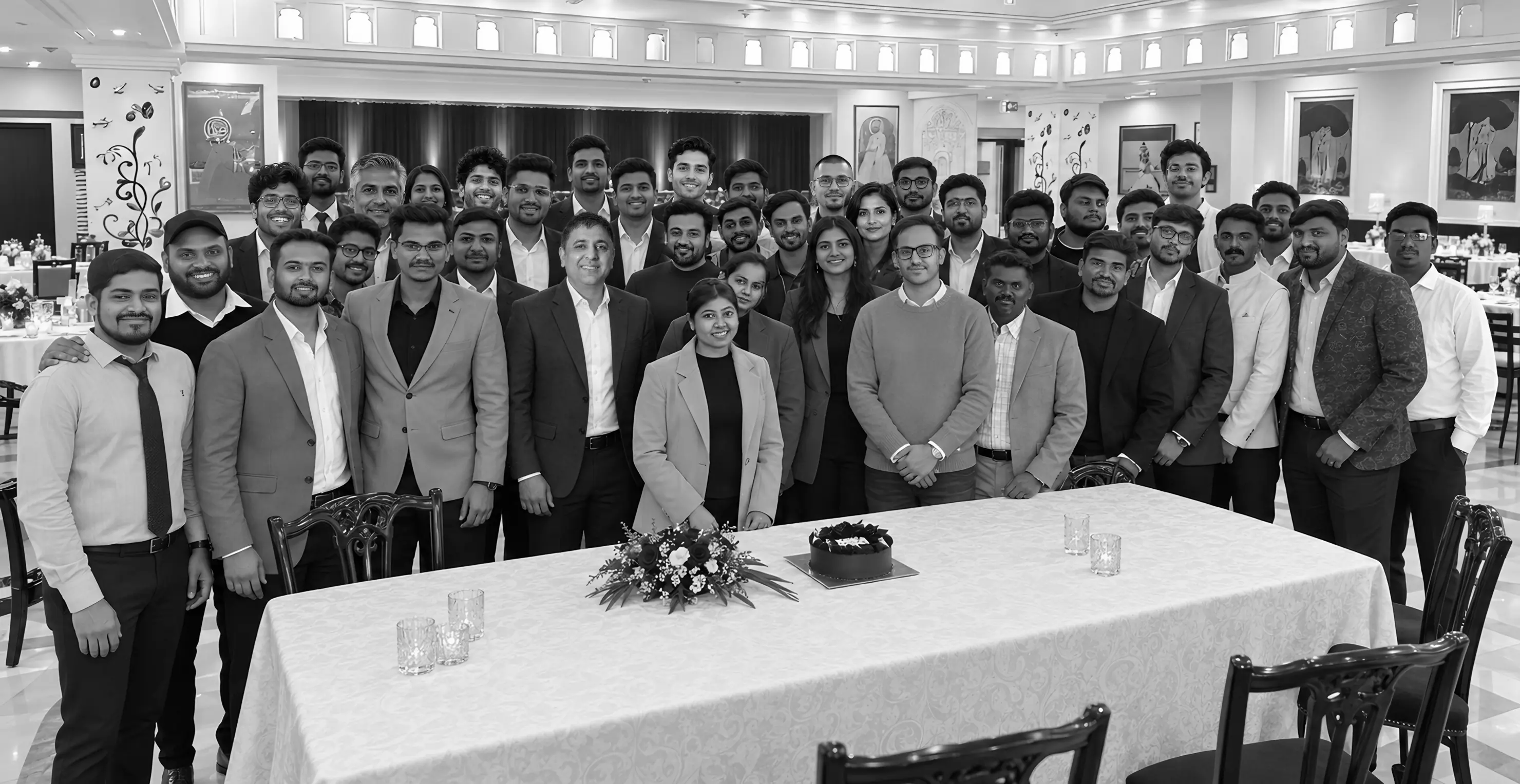
The people behind FORGE.
Learned in production
The standards in FORGE were learned on systems that had to work in production.
Each system that reached production taught us something a document could not. Which standard had to be enforced rather than advised. Which check found the failure before a customer did. What an operator has to know on its first night. Those lessons went into FORGE as standards, patterns and reference builds, so a new project starts from what the earlier ones learned. The platform is the firm's track record in a form you can build on.

What engagements leave behind
When an engagement ends, these stay with you:
- A working system in your accounts, deployed through a pipeline generated from your policy.
- The evidence of how it was built: each requirement linked to the work, and each decision to the person who made it.
- The standards, patterns and reference builds, as plain versioned files in your repository.
- For a cloud application, the operator that arrived with it and already knows it.
- A team that has worked in FORGE and the method, and keeps both.
Industries we work in
Our work concentrates where the cost of a wrong answer is highest and the record of how it was reached matters most.
The organisations named above span retail, energy and healthcare.
- Retail and supply chainIn retail, demand and supply are one flow seen from two sides, and a wrong forecast on either side becomes a stockout or an over-position. We build the two under one discipline, so the seam between them is engineered rather than left as a gap.
- Financial servicesIn financial services, a model is a regulated artefact, and the model-risk function has managed that for decades. We build AI systems into that existing discipline, so the evidence the validation team needs comes out of the build.
- HealthcareIn healthcare, a model error reaches a patient, and device, data and AI regulation overlap on the same system. Compliance is built into the delivery path rather than added afterwards.
- EnergyIn energy, a model error has physical consequences, in the grid, the plant or the safety system. The operator is built to catch the failure modes physical systems expose, and critical-infrastructure workloads run under their own governance.
Positions
A standard that cannot stop a build is advice.
An enterprise that has written down its architecture standards, security controls and coding guidelines still needs something that enforces them. A document in an AI tool's context has no power to refuse, and a rule that holds most of the time is not a control. FORGE puts the standard into the environment a project is built in and generates the pipeline from your policy. A standard is set once and every project inherits it. You do not start from a blank page: FORGE carries a published body of standards you adopt, override or extend. Before you change a standard you can see which projects it affects. Afterwards, a project that has fallen behind is caught at the moment of work. The path will not build against the superseded version until the project's owners take the change on.
Evidence is produced by the work, or it is reconstructed after it.
A compliance record written apart from the delivery record can be contradicted by the delivery it describes. In FORGE the record comes out of the build. It links each requirement to the work that implemented it and each decision to the person who made it. It names the model behind each role, the terms it works under, and the failures the system was tested against. A check that checks nothing counts as a failure unless the project has declared it does not apply, and missing evidence is a failed result. When an auditor asks how an AI-built application was designed, reviewed and approved, the answer is a lookup.
The decisions that carry risk belong to a named person.
AI drafts, investigates and checks. Predictable work runs as plain code, and a model is used where judgement is needed. People decide what to build, what to release and what an operator may touch. An AI agent does not approve its own work or set its own pass mark. The person who wrote a change does not approve it. The depth of review is worked out from the risk the change carries. It can be raised, and no one can lower it. Setting a check aside is itself recorded as a decision with a name on it. Who owns each decision is agreed in the engagement: your team, ours, or both.
Every build makes the next one better.
A failure met in production on one application is fed back into the patterns FORGE starts the next one from. The application after it is built with that failure prevented, or with a rehearsed response to it. A person decides what is promoted, and nothing learned elsewhere acts on your system until it has been proven on your system. The standards, patterns and reference builds live in your repository as plain, versioned files that you keep and can take elsewhere. Models are chosen by the role they play, so replacing a supplier's model is a change your governance already covers.
We say what we do not promise.
We do not promise perfect uptime, zero incidents, or a system that runs itself on day one. We do promise that the journeys you declared critical are watched. The operator checks its own alarms and alerts your team when its monitoring stops reporting. Each higher availability target is a priced choice you make with the numbers in front of you. The operator fixes the problems it has rehearsed. Its authority for each kind of action is earned in rehearsal and lapses if it is not renewed. Anything new is investigated under a spend ceiling and handed to a person with the likely cause and the evidence. Anyone on call can stop it at once, and releasing code stays with people. The view across your estate holds no credential and can send no command to any application. Speed is what the tooling gives you. Safe to ship is what we add.
The team
BtSavvy was founded in 2015 to deliver enterprise software, cloud and AI systems. The discipline on this page was learned running those systems in production. FORGE is what that discipline became: a product, so it could be applied to every project instead of remembered on each one. You can adopt it directly, or take it as the foundation of our engineering and operations services. We publish what we think as the FORGE Perspective series, for the engineers, architects and technology leaders deciding these questions now.
BtSavvy is a team of engineers, architects and operators who spent their careers building and running enterprise systems. The firm was founded to put that experience into engineering form. The people who shape the strategy have run production systems, and the people who operate a system read the same record the architects wrote. On every engagement, the decisions that carry risk have a named owner, from your team, ours or both.
Every engineer who joins BtSavvy spends their first six to eight months inside the firm's internal curriculum before they touch client work. It is training and certification across the whole lifecycle an engagement runs: code and architecture fundamentals, then cloud, DevSecOps, data and agentic AI engineering. BtSavvy trains its own engineers before they work for clients, and it is why the discipline looks the same from one engagement to the next.
Some of the organisations we work with
BtSavvy has provided engineering services to clients including:
- Conn's
- Oil States
- DocHealth
- Boston Children's Hospital
- GP&C Operations
Talk to BtSavvy about a workload.
Most engagements begin with the FORGE Diagnostic. It takes one workload you select and builds a working slice of it to your standards, inside your security controls. The pipeline is in place from the first commit. In 2 to 4 weeks it is deployed where you can watch it run. You keep the demonstration, its evidence and a readiness assessment, with a proposed next step.