FORGE is our product, an engineering platform. The Methodology page explains the method it runs, and the Engineering Brief argues it in full. This page says what the thing is and what it produces.
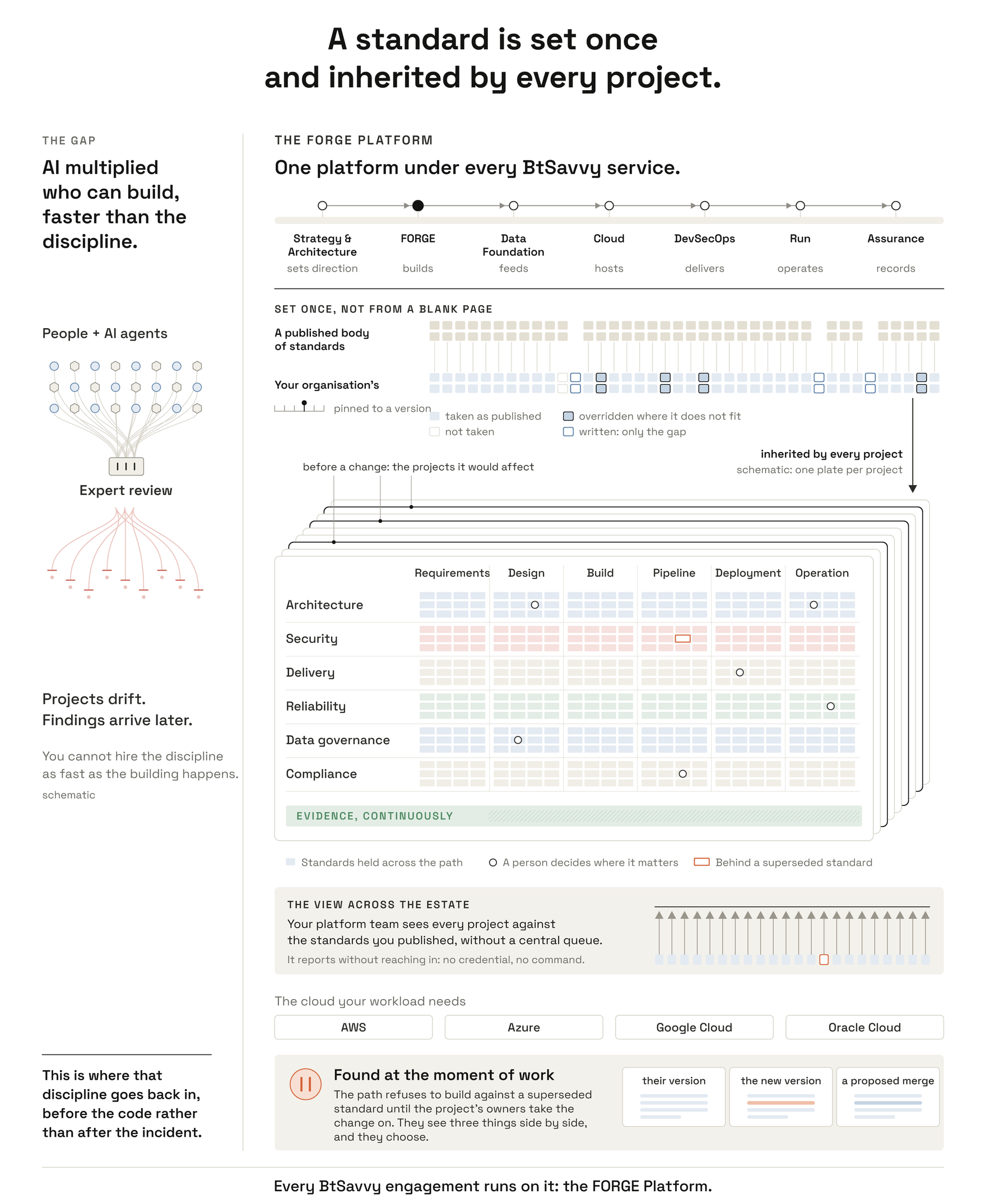
Your architects, security engineers and platform teams set their standards once. From those standards and a project's requirements, FORGE produces a complete engineering environment for that one project. It holds the design the software must satisfy and the tooling to build, deploy and operate it, with every rule already inside. The environment is fingerprinted when it is handed over, so what was handed over can be proved later. Drift from the design is a detectable defect rather than an argument. Your developers work in it with the AI tools they already use. What comes out is held to the standards and passes the same tests. It carries a traceable record from each requirement to the work that implemented it.
The environment takes a system the whole way. It starts with requirements, written new or recovered from the code, the documents and the running behaviour of a system you already have. The design is reviewed before any code is written. Work is built in units, each accepted before the next begins, and the tests are planned from the requirements first. Deployment is infrastructure-as-code on AWS, Azure, Google Cloud (GCP) or Oracle Cloud (OCI), whichever the workload needs. Operation begins with an operator built from the system's own design. The evidence is continuous across all of it, so an audit is a lookup, not a reconstruction.
The platform exists because AI multiplied who can build faster than the discipline that makes software safe to ship. This is where that discipline goes back in, before the code rather than after the incident.
One engine across every service
Every BtSavvy service runs on one platform. The path through them is a single line:
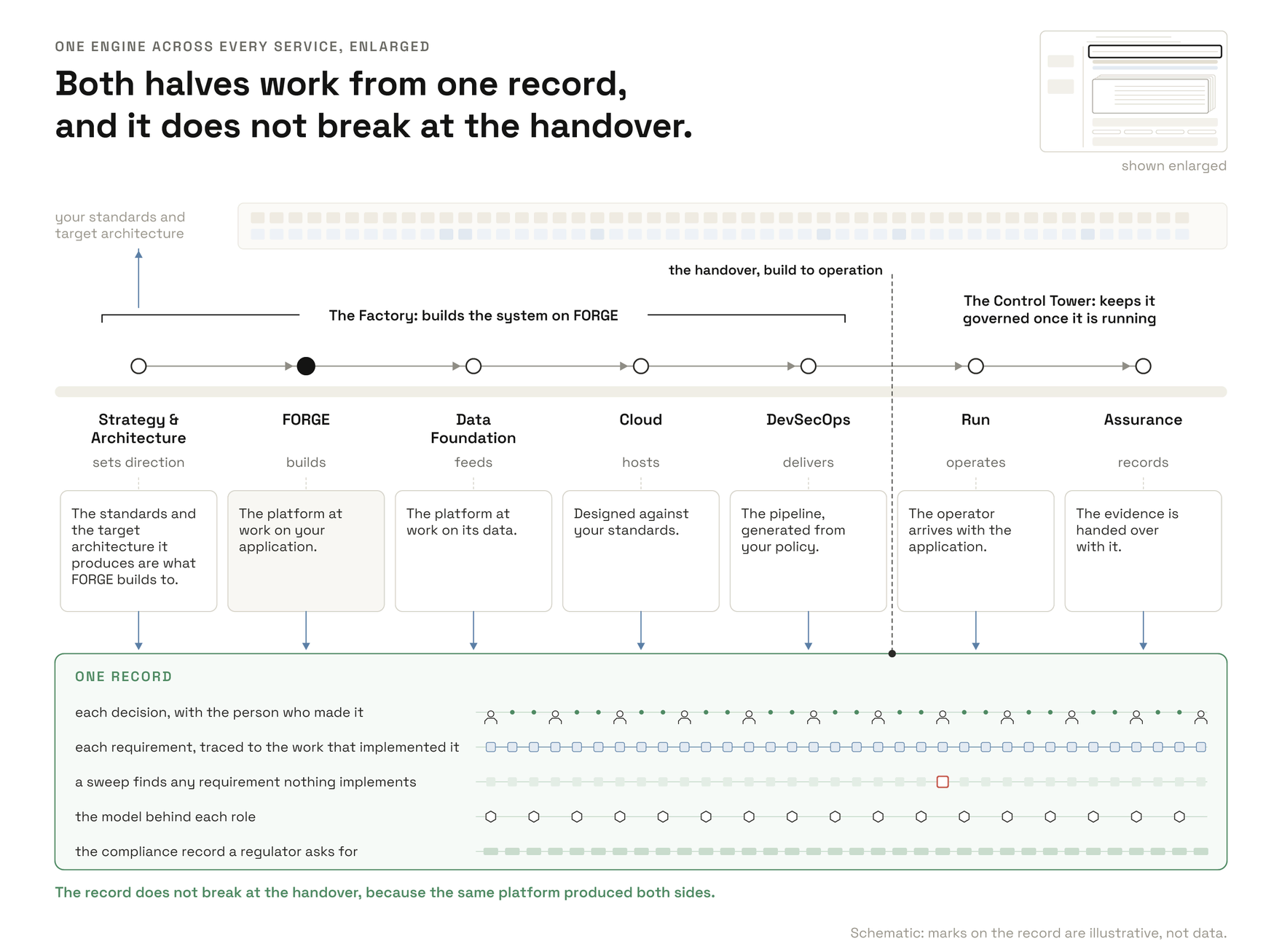
Strategy & Architecture sets direction → FORGE builds → Data Foundation feeds → Cloud hosts → DevSecOps delivers → Run operates → Assurance records.
Strategy & Architecture sits ahead of the platform: the standards and the target architecture it produces are what FORGE builds to. Build and Data Foundation are the platform at work on your application and on its data. Cloud, DevSecOps, Run and Assurance each carry what the platform produced into their own part of the work. The cloud is designed against your standards and the pipeline is generated from your policy. The operator arrives with the application, and the evidence is handed over with it.
The Factory services build the system on FORGE, and the Control Tower services keep it governed once it is running. Both halves work from one record. It carries each decision with the person who made it, and each requirement traced to the work that implemented it. A sweep finds any requirement nothing implements at all. It carries the model behind each role, and the compliance record a regulator asks for. The record does not break at the handover from build to operation, because the same platform produced both sides.
A standard is set once and inherited by every project, and it does not start from a blank page. FORGE carries a published body of standards. Your organisation takes what fits, pinned to a version, overrides what does not, and writes only the gap. Before you change a standard, you can see which of your projects it would affect. After you change it, a project that has fallen behind is found at the moment of work. The path refuses to build against a superseded standard until the project's owners have taken the change on. They see their version, the new version and a proposed merge side by side, and they choose. Your platform team sees every project against the standards you published, without a central queue. The view across every application in production reports on the estate without reaching into it. It holds no credential and can send no command to any application, so a compromise of it cannot act on your production.
What it builds, and where
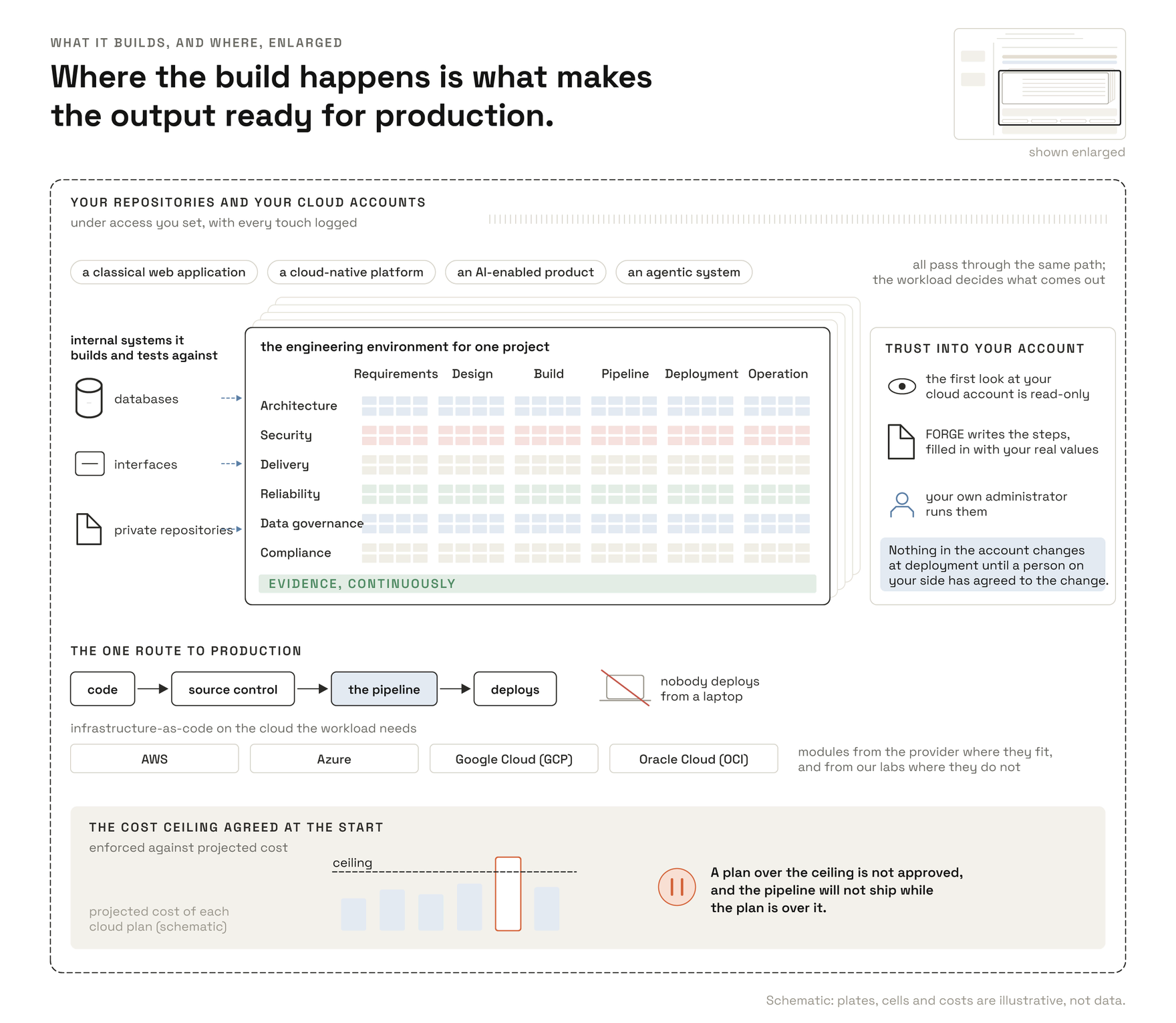
What comes out of the environment is the software itself: your product, end to end, rather than a scaffold a team finishes by hand. A classical web application, a cloud-native platform, an AI-enabled product and an agentic system all pass through the same path. The workload decides what comes out. The same path modernises what you already run. Where the work replaces a system you cannot afford to break, FORGE records what the old system did on real inputs. Those examples are taken from the old system, so the rebuild is measured against what that system actually did. The two run side by side on live traffic until you are satisfied.
The depth of checking is worked out from the risk a change carries. It can be raised, and it cannot be talked down. For the parts that must not fail, verification goes further than testing, and the most critical parts carry machine-checked proofs.
Where the build happens is what makes the output ready for production. The environment runs inside your own repositories and cloud accounts, under access you set, with every touch logged. It can see the internal databases, interfaces and private repositories the application has to work with, and it builds and tests against them. What ships fits the enterprise it runs in, from the first commit. The first look at your cloud account is read-only. Where the pipeline needs trust into that account, FORGE writes the steps, filled in with your real values, for your own administrator to run. Nothing in the account changes at deployment until a person on your side has agreed to the change. Nobody deploys from a laptop: code goes to source control, source control starts the pipeline, and the pipeline deploys.
The cloud and the pipeline are built to your standards in the same way. Your cloud architects define the platform architecture, its standards and its security controls once. Every project's cloud is designed against them and delivered as infrastructure-as-code on AWS, Azure, Google Cloud (GCP) or Oracle Cloud (OCI). The modules come from the provider where they fit and from our labs where they do not. The cost ceiling agreed at the start is enforced against projected cost. A cloud plan over the ceiling is not approved, and the pipeline will not ship while the plan is over it.
Your DevOps and security teams set the pipeline policy once, and each project's pipeline is generated from it. It works with the pipeline tooling you already run, hosted or on premises. Full DevSecOps deployment across all four clouds, with the checks and the evidence part of the path itself. The policy runs on a change an AI proposed exactly as it runs on one a person wrote, and production approval cannot be waived. A secret value goes into your vault by a route that never passes through the AI tools or any file. Each deployment identity is scoped to the work it does.
Your teams keep their AI coding tools and their pace. FORGE sits on top of those tools and changes what they produce. The code is written against your architecture, security and compliance standards from the start, and what built the code does not judge it. A check that checks nothing counts as a failure unless the project has declared it does not apply. Missing evidence is a failed result, never a claimed success. Your organisation decides which models may work near your source code, on what terms and in which regions. That question is kept apart from which models your customers meet in the product.
BtSavvy's forward-deployed engineers build on FORGE with your team, inside your environment, and teach the product and the discipline as they go. What they leave behind is a capability your team owns. The standards, the patterns and the reference builds stay in your repository as plain, versioned files, for every build that follows. A new project discovers what the ones before it built and expose, and starts from there. That is also how a capability you would otherwise rent as SaaS gets built in-house, to the standard a SaaS provider holds itself to. FORGE supplies the design, the tooling and the operator. Your team builds the part that is specific to your business, without building a full application from scratch, and owns all of it. What gets built lives where your work already lives, so changing a supplier does not mean changing the system.
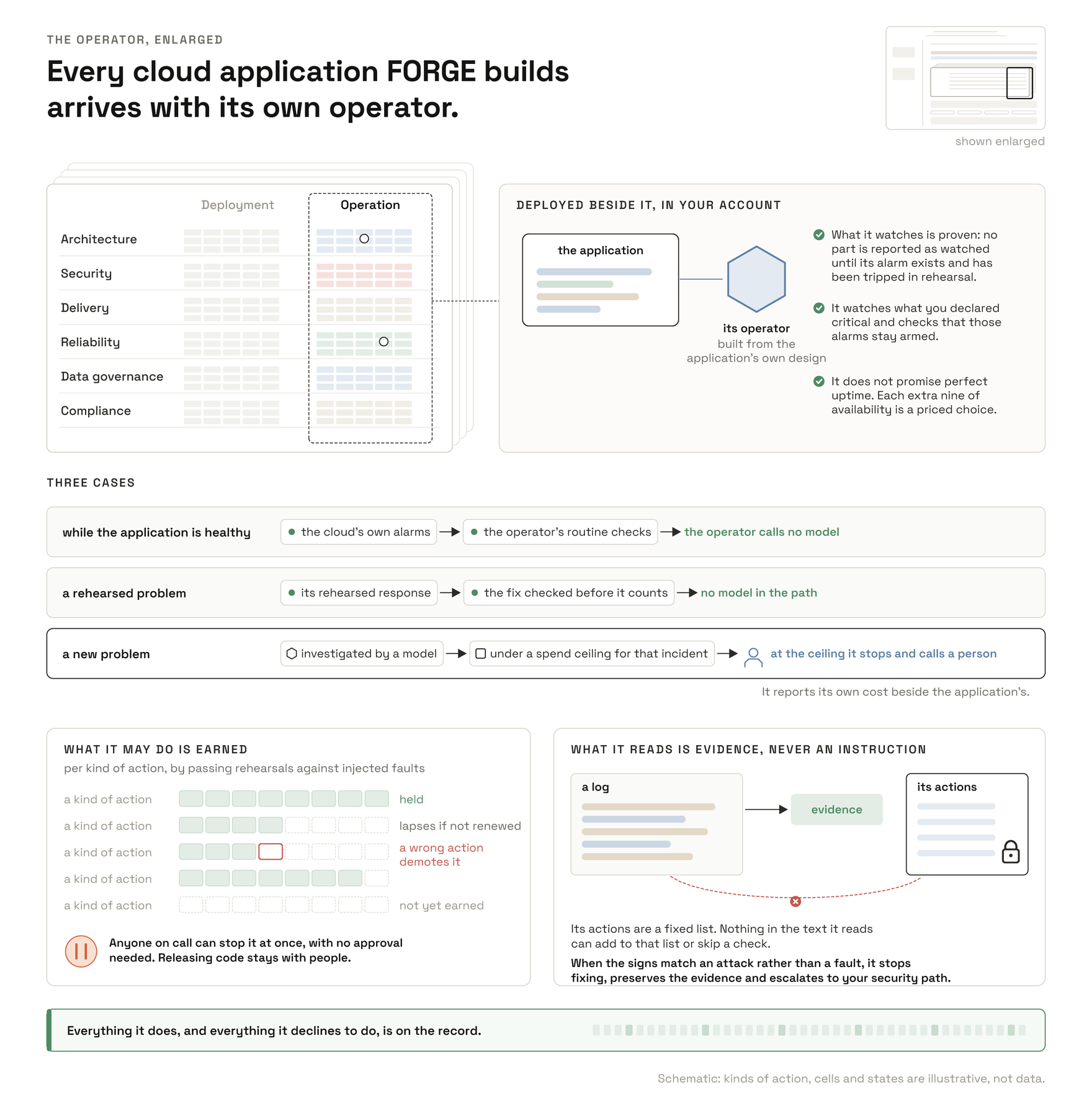
Every cloud application FORGE builds arrives with its own operator, built from the application's own design and deployed beside it in your account. What it watches is proven: no part of the application is reported as watched until its alarm exists and has been tripped in rehearsal. It does not promise perfect uptime. It watches what you declared critical and checks that those alarms stay armed. Each extra nine of availability is a priced choice. While the application is healthy, the cloud's own alarms and the operator's own routine checks do the watching, and the operator calls no model. A rehearsed problem gets its rehearsed response, with no model in the path, and the fix is checked before it counts. A new problem is investigated by a model under a spend ceiling for that incident. At the ceiling it stops and calls a person, and it reports its own cost beside the application's.
What it may do is earned, per kind of action, by passing rehearsals against injected faults. That authority lapses if it is not renewed, and a wrong action demotes it. Anyone on call can stop it at once, with no approval needed, and releasing code stays with people. What it reads in a log is evidence, never an instruction. The actions it may take are a fixed list, and nothing in the text it reads can add to that list or skip a check. When the signs match an attack rather than a fault, it stops fixing, preserves the evidence and escalates to your security path. Everything it does, and everything it declines to do, is on the record.
The platform is agentic in how it works, whatever it builds. Inside the environment, predictable work runs as plain code and a model is used where judgement is needed. Context engineering, review at every stage and automated verification make it fast and reliable, whatever it produces. An enterprise evaluating it for a classical application is not being asked to take on agents it never asked for.
Evaluate the platform against a real workload.
The FORGE Diagnostic takes one workload you select and builds a working slice of it on FORGE. It is built to your standards, inside your security controls, with the pipeline in place from the first commit. In 2 to 4 weeks it is deployed where you can watch it run. Beside it you get a readiness assessment of how your current delivery compares, and a proposed next step. The Diagnostic runs on the platform this page describes, so the record you see is produced against your own workload. You keep the demonstration, its evidence and the assessment, as files in your own repository.