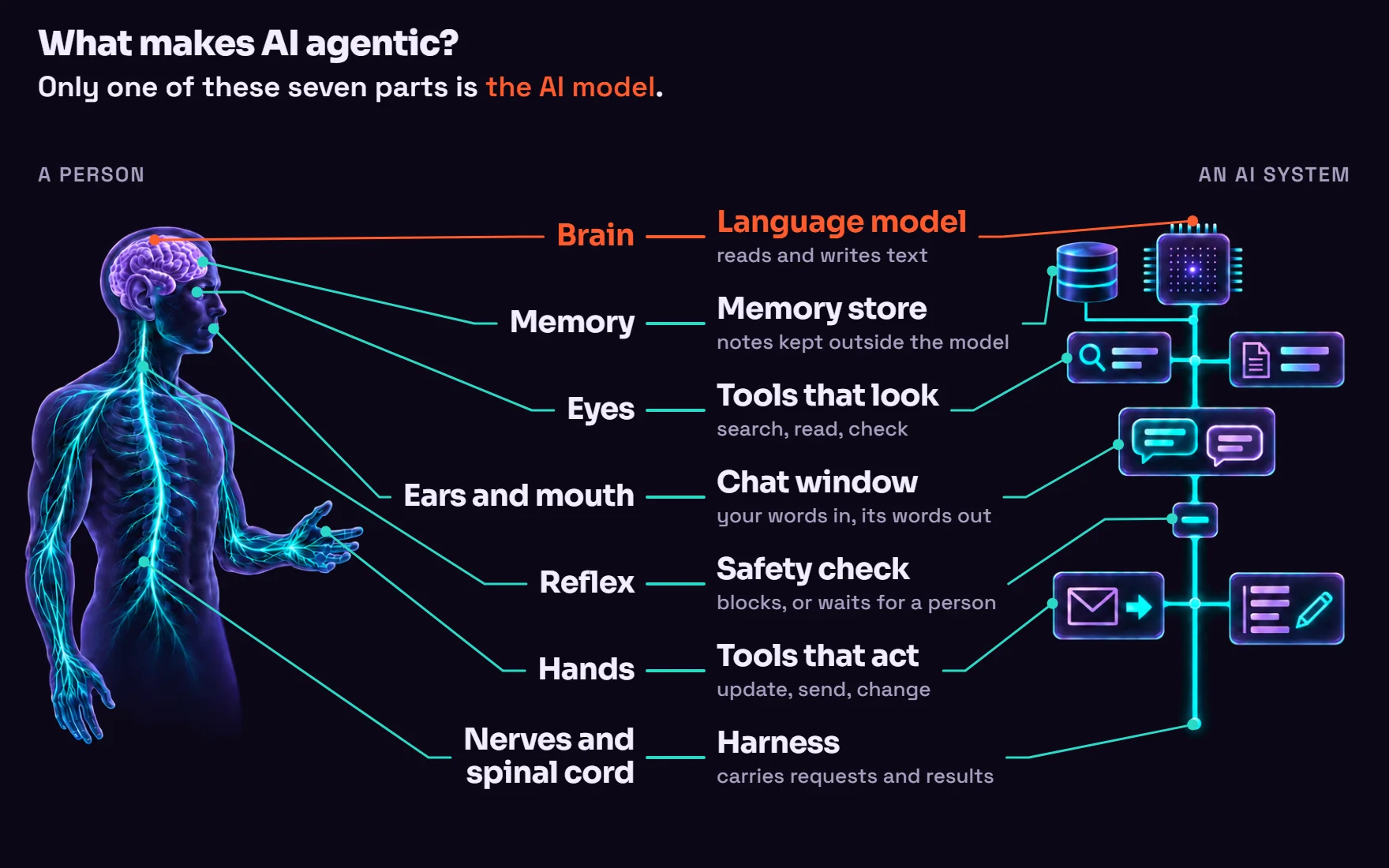
The difference between an AI model, a chat assistant and an agentic system, explained with the human brain and body. The model is the brain. The software built around it is the body. An agent is the whole person: brain and body working together.
Not a new question
The difference between an AI model and an AI agent isn’t a new topic. Researchers, vendors and engineers have written about it for years, and the debate about where to draw the line is still going. Many people already understand it well.
Many others are still unsure. They use a chat assistant at work and hear “generative AI” and “agentic AI” in vendor meetings. They also see the word “agentic” on products that work in different ways. This paper is one more way to explain the difference at the most basic level, using something everyone knows: a person’s brain and body.
The comparison isn’t new either. A standard AI textbook uses a person to explain what an agent is. A person senses through “eyes, ears, and other organs” and acts through “hands, legs, mouth, and other body parts” (Russell and Norvig, 2003). One researcher describes the model as “the agent’s brain” (Weng, 2023). The comparison is about the job each part does. It says nothing about whether a model thinks the way a person does.
The brain: the AI model
Most of today’s chat assistants and AI agents are built around a large language model (LLM). Generative AI is AI that produces new content, such as text or images. In these products, the part that generates is the language model, and what it mostly generates is text: answers, and requests to use tools.
A language model is software that “predicts upcoming words” (Jurafsky and Martin, 2026). Give it some text and it predicts a likely next piece, adds it, and repeats, one small piece at a time. The models behind today’s assistants are then trained further to follow instructions and give helpful answers (Anthropic, 2026a). That training is finished before the model is put to use, and using the model doesn’t change it. Within a conversation, it can still use the examples and results it is given.
That is all the model does. It takes in what it is given, mostly text and sometimes images or sound, and writes a reply. On its own it can’t look anything up, open a file or send an email. It also keeps nothing from one request to the next (Anthropic, 2026b). For each reply, the software around it sends the earlier messages again, or a summary of them.
So the model is a brain with no body. It can write the email to your supplier. It can’t send it.
The body: the software around it
Everything else is software that people build around the model. In this comparison, that software is the body.
A plain chat assistant is a brain with ears and a mouth. The chat app carries your question to the model and shows you the model’s answer. If the answer is an email to your supplier, you are the one who sends it.
An agentic system gives the brain eyes and hands as well. The software gives the model tools, and in an agent the model chooses which one to use next. Some tools work like eyes. They look something up in a business system, read a document or check a result, and report what they found. Others work like hands. They update a record, send an email or change a file. Some do both.
The software that connects the brain to the tools works like the nerves and the spinal cord. Engineers often call it the harness. Put the brain and the whole body together, and you have the agent: the whole person.
The model doesn’t move the hand itself. It writes a request in a set format. The request names a tool and what to give it, such as the invoice tool with “status: overdue”. The software reads the request and checks it against any rules people have set. If the rules allow it, the software runs the tool. If not, it refuses or waits for a person to approve. Either way, it sends the outcome back to the model. One AI lab’s documentation says it plainly: “The model never executes anything on its own” (Anthropic, 2026c). Another lab’s documentation says the same: your code takes the “actions suggested by the model” (OpenAI, 2026).
The model reads the outcome and writes its next request, and the software handles that one too. This repeats until the model says it has finished, or a limit stops it. One software engineer puts the whole idea in a sentence: “An LLM agent runs tools in a loop to achieve a goal” (Willison, 2025). The model saying it has finished doesn’t prove the work is right.
The map, part by part
- The whole person is the agent: the brain and the body working together.
- The brain is the language model.
- What a person has learned is what the model learned in training.
- What you are holding in mind right now is what is in front of the model right now. That is the instructions, your request, the conversation so far and the tool results. The space has a limit, which engineers call the context window.
- The ears and mouth are the chat app.
- The eyes are tools that look: search, read a document, check a business system or read a result.
- The hands are tools that act: update a record, send an email, change a file or make a payment.
- The nerves and spinal cord are the harness, the software that carries requests to the tools and results back.
- Reflexes are the automatic safety checks in that software. A reflex pulls your hand off a hot stove before you have consciously decided anything. These checks act on the model’s request without asking the model. They block what isn’t allowed, and some go further than any reflex and hold the action until a person approves it.
- Remembering yesterday is a memory store. Nothing stays in the model between requests. Where a memory store is switched on, the software saves notes and hands them back in a later conversation. Here the comparison bends, because a person keeps memories in the brain.
- A goal is the task you give it. A person chooses their own goals. An agent works toward the one it is given.
- Look, act and look again is the agent loop.
Two examples
A glass of water. Ask a brain with only ears and a mouth whether you should drink some water, and it says yes, it’s good for you. You get up and pour it. A brain with a body would see the empty glass, fill it, check that it’s full and hand it to you. If the glass were scalding, a reflex would pull the hand back before the brain had decided anything.
Overdue invoices. Ask a plain chat assistant how to chase customers who haven’t paid, and it writes a reminder email for you. You find the overdue invoices, send the emails and keep track of the replies. Now give the same task to an agentic system that can use the finance system and email. It looks up which invoices are overdue (eyes). The model writes each reminder and a tool sends it (hands). Later it checks for replies and payments (eyes). The model uses what it finds to decide whether to send another reminder or pass the case to a person. A safety check might hold any email to a major customer until a person approves it.
The model can be the same with or without the body.
Why the word gets stretched
“Agentic” is used for products that work in different ways, partly because the sources draw the line in different places. One vendor’s guide says an application is not an agent unless the model controls how the work proceeds. It gives “simple chatbots” as an example of what is not an agent (OpenAI, 2025). Another vendor uses “agentic systems” for two kinds: fixed, step-by-step workflows, and systems where the model directs its own steps. It keeps the word “agent” for the second kind (Anthropic, 2024). An AI educator suggests thinking of systems as “agent-like to different degrees” (Ng, 2024).
Products blur the line too. Many chat assistants now have some eyes, such as web search, and some have hands, such as adding an event to your calendar. Some products follow fixed steps that someone wrote, and some let the model choose what happens next. The chat window tells you little, because an agentic system can sit behind the same one.
What to ask when you hear “agentic”
The body decides what the brain can reach, so most of the useful questions are about the body, and about who chooses each step.
- Who chooses the next step? Does the model decide what to do next, or does it follow a fixed sequence that someone wrote?
- What can it see? Which systems and documents can its tools read?
- What can it do? Which systems can it change? Can it spend money or contact customers?
- What stops it? Which actions are blocked, which need a person’s approval, and who set those rules?
- How does it know it has finished? What does it check before it reports the task as done? What limit stops it if it can’t finish?
- What record does it keep? Can you see each request it made, what the software allowed and what came back?
The body can also change the results. On a public test of coding tasks, one model was reported to solve 45.9% of the tasks in a standard test setup. The same model was reported to solve 55.4% in its maker’s own harness (Zhang et al., 2026). When you compare agentic products, you are comparing the brain and the body together.
References
- Anthropic, “Building effective agents”, 19 December 2024 (2024). Workflows and agents; “agentic systems”. Vendor. Source
- Anthropic, Glossary, read 10 October 2026 (2026a). “Claude is not a bare language model; it has already been fine-tuned to be a helpful assistant.” Vendor. Source
- Anthropic, “Working with the Messages API”, read 10 October 2026 (2026b). Vendor. Source
- Anthropic, “How tool use works”, read 10 October 2026 (2026c). Vendor. Source
- D. Jurafsky and J. H. Martin, Speech and Language Processing, chapter 3, draft of 19 August 2026. Textbook. Source
- A. Ng, The Batch, issue 253, 12 June 2024. Practitioner. Source
- OpenAI, A practical guide to building agents, April 2025 (2025). Vendor. Source
- OpenAI, “Function calling” documentation, read 10 October 2026 (2026). Vendor. Source
- S. Russell and P. Norvig, Artificial Intelligence: A Modern Approach, 2nd edition, chapter 2, 2003 (sample chapter). Textbook. Source
- L. Weng, “LLM Powered Autonomous Agents”, 23 June 2023. Practitioner. Source
- S. Willison, “I think ‘agent’ may finally have a widely enough agreed upon definition to be useful jargon now”, 18 September 2025. Practitioner. Source
- Zhang et al., “Stop Comparing LLM Agents Without Disclosing the Harness”, arXiv 2605.23950, 7 May 2026. Position paper. The 45.9% and 55.4% figures (Claude Opus 4.5 on SWE-bench Pro, under the standardised SEAL scaffold and under Claude Code) come from Morph’s SWE-bench Pro leaderboard, which the paper cites; they are two reported runs, not a controlled test. Preprint. Source
The FORGE Diagnostic takes one workload you select. It shows what your AI agents can read and change, which actions need a person’s approval, and which limits are enforced in software. You get a readiness assessment and a proposed next step.